WASHINGTON, D.C. October 1, 2026
A new Government Accountability Office report raises serious questions about what Congress and the public still do not know about Department of Government Efficiency activity inside the Department of Veterans Affairs.
The September 29, 2026 GAO report does not establish that DOGE improperly accessed veterans’ medical records or stole veterans’ personal information.
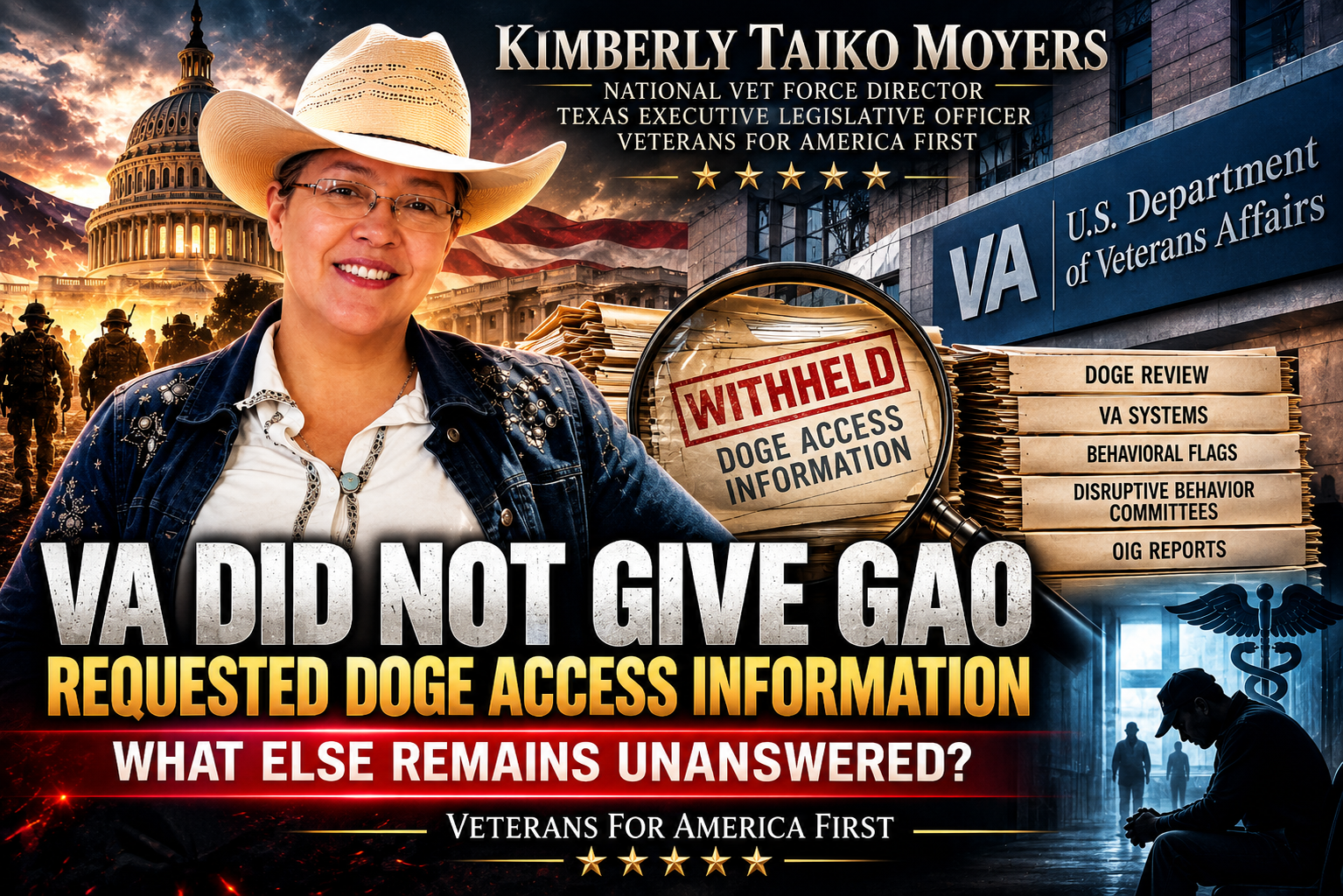
What it does establish is that VA did not provide GAO with requested information identifying which systems its DOGE team members could access.
GAO reviewed six federal agencies to determine which information systems their DOGE teams could access and whether the agencies had implemented controls to ensure compliance with information security requirements.
Four agencies provided information concerning system access.
VA and the Small Business Administration did not.
GAO also reported that VA did not respond to requests for information concerning whether appropriate controls had been implemented to ensure DOGE team members followed VA information security rules.
That is significant.
But it also raises a bigger question.
If GAO could not obtain a complete accounting of the VA systems DOGE personnel could access, how much does Congress actually know about what DOGE examined inside VA?
WHAT DID DOGE ACTUALLY EXAMINE?
VA previously told Congress that four VA employees serving as DOGE liaisons were working to streamline operations, improve management and examine contracts.
VA Secretary Doug Collins also told Congress that DOGE did not have access to veterans’ personal records and that the VA employees serving as DOGE liaisons were subject to the same rules, standards and access limitations as other VA employees.
That assurance matters.
GAO did not conclude that DOGE breached medical records.
GAO did not conclude that DOGE stole protected health information.
GAO did not conclude that DOGE improperly obtained veterans’ personal records.
The problem identified in the latest report is that VA did not provide GAO enough information to independently determine which systems DOGE personnel could access.
That leads to questions Congress should be asking now.
What VA programs did DOGE examine?
What internal systems did DOGE review?
What findings did DOGE produce?
What waste did DOGE identify?
What contracts did DOGE question?
What management failures did DOGE uncover?
Were any requests for information denied or limited?
Were there parts of VA that DOGE could not examine?
And did VA fully cooperate with DOGE in the first place?
The September 29 GAO report does not answer those questions.
VA’S OWN RECORD REQUIRES SCRUTINY
VA should not be treated as an institution whose own assurances automatically end the discussion.
The Department has a documented history of management failures significant enough to require repeated intervention by Congress, GAO and VA’s own Office of Inspector General.
One major example involved executive incentive payments.
VA OIG concluded that VA improperly awarded $10.8 million in critical skill incentive payments to 182 senior executives at VA central office.
Individual awards ranged from nearly $39,000 to more than $100,000.
OIG found that incentives awarded to nearly all Veterans Health Administration and Veterans Benefits Administration central office executives lacked adequate justification and were inconsistent with the PACT Act and VA policy.
The investigation identified breakdowns in leadership and internal controls, insufficient transparency, excessive deference to senior officials, missed opportunities to identify legal problems and failures in VA governance.
VA later took corrective action.
But correcting a failure does not erase the failure.
It proves why outside scrutiny matters.
If DOGE was inside VA examining spending, management and contracts, did DOGE look at how these failures happened?
Did it determine whether similar practices were still occurring elsewhere?
Did it examine whether money intended to serve veterans was instead being consumed by unnecessary contracts, bureaucracy or executive incentives?
Those are legitimate questions.
SENATOR MARSHA BLACKBURN RAISED VA EMPLOYEE CONDUCT IN 2026
Concerns about the way veterans are treated by some VA employees have also reached the United States Senate.
During a July 22, 2026 Senate Committee on Veterans’ Affairs hearing, Senator Marsha Blackburn discussed complaints received by her Tennessee offices.
Blackburn described one of the biggest complaints reaching her offices as problems involving VA caseworkers and delays in veterans receiving responses.
She also criticized what she described as employee rudeness, lack of caring and employees focusing on themselves instead of the veteran.
She reminded the committee that VA exists to serve veterans.
That deserves attention.
If members of the United States Senate are receiving significant complaints about the conduct of VA employees, Congress should not simply examine the veteran when a confrontation occurs.
It should examine the employee too.
DISRUPTIVE BEHAVIOR COMMITTEES DESERVE A MUCH DEEPER LOOK
VA operates an internal system involving Disruptive Behavior Committees, Behavioral Patient Record Flags, Orders of Behavioral Restriction and the Disruptive Behavior Reporting System.
These programs are intended to protect employees, veterans and visitors from genuine threats.
That is a legitimate purpose.
But the existence of a legitimate purpose does not mean the system is incapable of failure or abuse.
Veterans have complained that encounters with VA personnel can be exaggerated or mischaracterized and that veterans who challenge poor treatment can subsequently be labeled disruptive or threatening.
That raises a basic question.
Who independently determines whether the accusation against the veteran was actually true?
Was the veteran threatening?
Was the allegation corroborated?
Were witnesses interviewed?
Was video reviewed when available?
Was the VA employee’s conduct examined?
Did the veteran previously complain about the employee or facility?
Was the veteran given meaningful notice and an opportunity to challenge what was entered into the record?
If the veteran alleged retaliation, who investigated the allegation independently?
These questions matter because a behavioral flag can affect how a veteran is treated throughout the VA health care system.
VA OIG HAS ALREADY FOUND PROBLEMS
The VA Office of Inspector General has documented deficiencies involving disruptive behavior procedures.
A national OIG review found significant variation among VA facilities in how disruptive behavior was defined, documented and managed.
Inspectors identified delays involving Patient Record Flags.
Later reviews identified problems involving required participation in Disruptive Behavior Committee meetings, patient notification of restrictions and completion of required employee training.
OIG has also found cases where veterans were not properly informed that Patient Record Flags had been placed in their medical records or told that they could request amendment or appeal.
At the Orlando VA Medical Center, OIG reported that 25 of 37 applicable electronic health records contained no evidence that clinicians had informed patients about their flags and their ability to seek amendment or appeal.
Those are documented failures.
But they still leave an even bigger question unanswered.
HOW MANY FLAGS WERE ACTUALLY WRONG?
Existing oversight has largely examined whether VA followed its own procedures.
Did the committee meet?
Was the paperwork completed?
Was the veteran notified?
Were required personnel present?
Was training completed?
Those questions matter.
But they do not answer whether the underlying accusation against the veteran was true.
We have not identified a nationwide independent audit determining how many Behavioral Patient Record Flags were unsupported, inaccurate, exaggerated or retaliatory.
We have not identified a nationwide audit determining how many veterans were flagged after complaining about employee misconduct, poor care or mistreatment.
We have not identified a nationwide audit determining how many retaliation allegations were independently investigated.
We have not identified a national accounting showing how many flags were amended or removed because the underlying accusation could not be sustained.
That does not prove widespread abuse.
It proves that an important question has not been answered nationally.
Employee safety matters.
Veteran due process matters too.
DID DOGE EXAMINE THIS?
This is where the DOGE question becomes much larger than cybersecurity.
If DOGE was examining VA management, contracts, spending and institutional efficiency, did its review ever reach the Disruptive Behavior Committee system?
Did DOGE examine Behavioral Patient Record Flags?
Did DOGE examine Orders of Behavioral Restriction?
Did DOGE examine the Disruptive Behavior Reporting System?
Did DOGE examine allegations of retaliation against veterans who complained about employees?
Did DOGE compare employee misconduct complaints with behavioral actions subsequently taken against those veterans?
Did DOGE determine how much these programs cost?
Did DOGE identify inconsistencies among VA facilities?
Did DOGE recommend reforms?
And if DOGE attempted to examine these issues, did VA cooperate?
We do not currently have evidence proving DOGE conducted such a review.
We also do not have evidence proving VA stopped DOGE from doing so.
Those remain unanswered questions.
The GAO report does not resolve them.
DID VA LIMIT WHAT DOGE COULD SEE?
GAO reported that VA did not provide the requested information identifying which systems DOGE personnel could access.
That means Congress still lacks a complete independent accounting of the scope of DOGE system access inside VA.
This does not prove VA obstructed DOGE.
But it absolutely justifies asking whether VA fully cooperated with DOGE and whether DOGE had access to everything it needed to evaluate waste, management failures and institutional practices.
If DOGE encountered resistance inside VA, Congress should know.
If programs were placed outside DOGE’s review, Congress should know.
If DOGE uncovered serious problems, Congress should see those findings.
And if DOGE examined a program and found nothing wrong, that information should be available as well.
WHO WATCHES THE WATCHDOG?
GAO is Congress’s auditing and investigative arm and is structured to operate independently from the executive agencies it examines.
That independence is important.
It does not mean veterans should blindly trust another government institution.
Every watchdog should be judged by the evidence it produces.
In this case, GAO openly acknowledges an important limitation.
VA did not provide critical information that GAO requested.
Congress should therefore ask what GAO requested, what VA supplied, what VA did not supply and what steps were taken to obtain the missing information.
If GAO has statutory authority to obtain those records, what happens when an agency does not provide them?
Does Congress compel production?
Does anyone face consequences?
Or does another government report simply state that information was not provided before everyone moves on?
Government investigating government cannot become a closed circle where nobody is ultimately accountable.
The underlying records matter.
THIS IS BIGGER THAN DOGE
The issue is not whether someone likes or dislikes DOGE.
The issue is whether veterans received meaningful accountability.
If DOGE identified waste, release the evidence.
If DOGE identified unnecessary contracts, show Congress.
If DOGE uncovered management failures, release the findings.
If DOGE investigated employee misconduct, retaliation, behavioral flags or other systems affecting veterans, show what it found.
If DOGE did not investigate those issues, Congress should ask whether someone should.
If VA limited DOGE’s ability to conduct its review, Congress should determine exactly what was restricted and why.
If DOGE itself violated a law or mishandled protected information, produce that evidence too.
No institution deserves automatic trust.
Not VA.
Not DOGE.
Not GAO.
The facts should decide.
RELEASE THE RECORDS AND AUDIT THE SYSTEM
Congress should obtain a complete accounting of DOGE’s activities inside the Department of Veterans Affairs.
That should include the systems DOGE personnel could access, the contracts and programs reviewed, recommendations produced, records requested and any restrictions placed on DOGE’s work.
Congress should also consider a truly independent national audit of Behavioral Patient Record Flags and Disruptive Behavior Committees.
Not another review that simply asks whether VA completed its paperwork.
An audit that examines whether the underlying accusations against veterans were factually supported.
How many flags were appealed?
How many were amended?
How many were removed?
How many veterans alleged retaliation?
How many flags followed complaints about VA employee misconduct?
How many disputed encounters were independently investigated?
How often were the actions of VA employees examined alongside the actions of the veteran?
Those are questions veterans deserve answered.
The September 29 GAO report does not prove that VA concealed misconduct from DOGE.
It does not prove behavioral flags were systematically retaliatory.
It does not prove DOGE uncovered abuses involving Disruptive Behavior Committees.
But it also does not answer those questions.
What it establishes is important enough.
VA did not give Congress’s watchdog requested information concerning which systems DOGE personnel could access.
Given VA’s documented history of management failures, improper executive incentives and deficiencies involving disruptive behavior procedures, that should not end the investigation.
It should expand it.
Veterans deserve the records.
Veterans deserve independent scrutiny of allegations made against them and complaints made by them.
Veterans deserve an oversight system willing to examine the institution with the same seriousness with which the institution examines the veteran.
Veterans for America First
Veterans First
Latest News
VA DID NOT GIVE GAO REQUESTED DOGE ACCESS INFORMATION. WHAT ELSE REMAINS UNANSWERED?
- by: Kimberly Taiko Moyers
- 2026-10-01
- Source:
https://yournews.com/2026/10/01/7213151/va-did-not-give-gao-requested-doge-access-information-what/

- 10/01/2026
