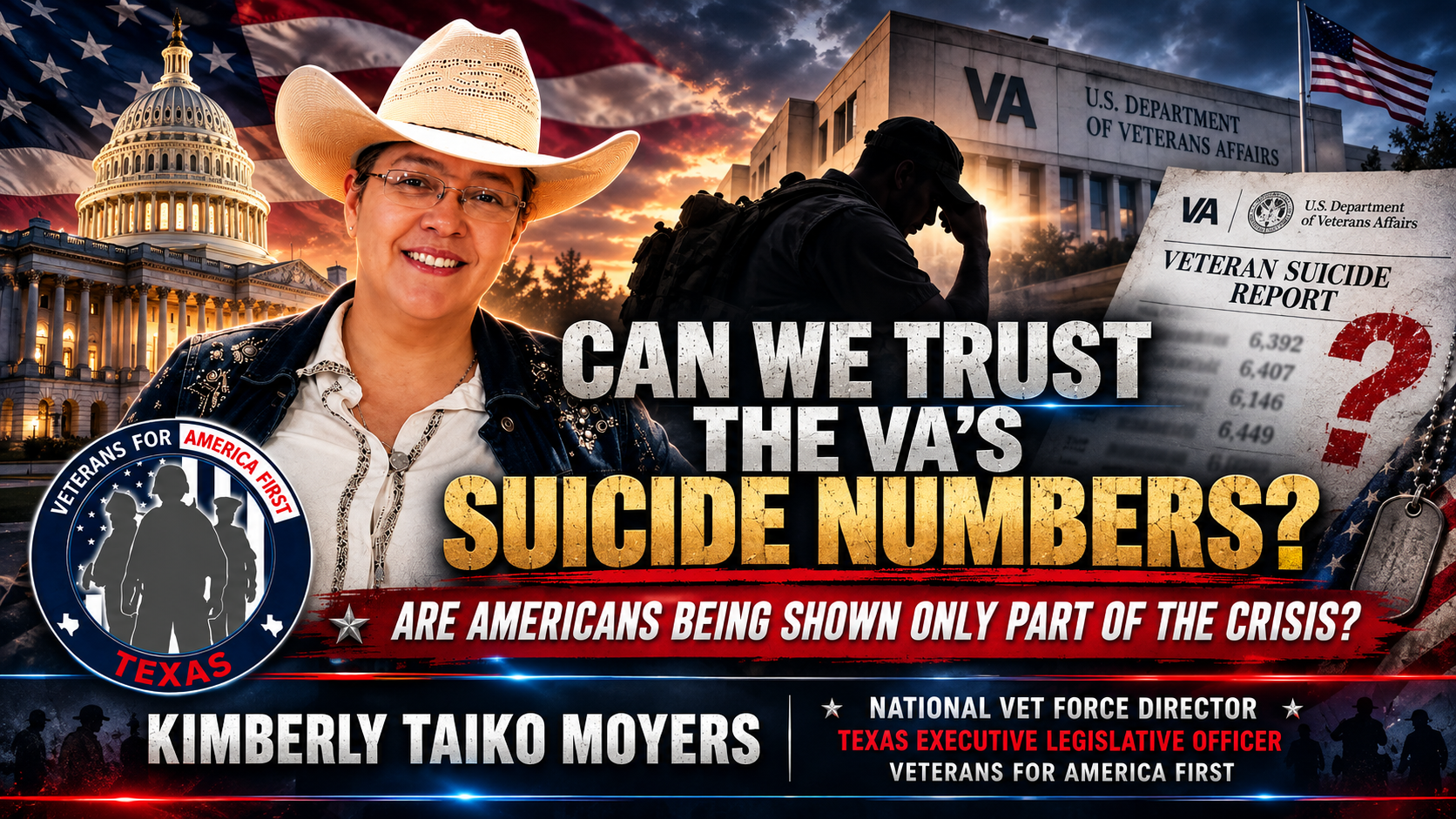
CAN WE TRUST THE VA’S SUICIDE NUMBERS, OR ARE AMERICANS BEING SHOWN ONLY PART OF THE CRISIS?
By Kimberly Taiko Moyers
National Vet Force Director
Veterans for America First
The Department of Veterans Affairs released its 2026 National Veteran Suicide Prevention Annual Report on September 30, reporting that 6,488 veterans died by suicide in 2024. That equals 17.7 veterans every day. VA also reports that 62 percent of those veterans had not received VA health care during the year they died or the year before. [VA News](https://news.va.gov/press-room/va-releases-annual-veteran-suicide-prevention-report-updated-with-2024-data/?utm_source=chatgpt.com)
Those numbers are devastating. But they also deserve context.
Americans spent years hearing that roughly 22 veterans or military connected Americans were dying by suicide every day. Then the number began appearing as roughly 17 veterans per day.
What changed?
In 2019, VA itself announced a major change in the way it reported suicide deaths. VA stopped grouping veterans eligible for VA services together with current servicemembers and former National Guard and Reserve members who had never been federally activated. VA said those populations would thereafter be reported separately, with the Department of Defense publishing separate suicide information for servicemembers. [VA News](https://news.va.gov/press-room/va-releases-2019-national-veteran-suicide-prevention-report/?utm_source=chatgpt.com)
That means today’s 17.7 figure is a veteran figure. It does not include the servicemembers whose suicide deaths are now reported separately by DoD.
That distinction should be made unmistakably clear whenever the public is told the veteran suicide number has declined.
The government did not eliminate those military deaths by separating the reports.
The families did not stop burying sons, daughters, husbands, wives, brothers and sisters simply because one federal agency reports one population and another agency reports the other.
And the latest VA report itself does not describe a crisis that has disappeared.
VA reports 6,488 veteran suicides in 2024. Sixty two percent of those veterans were outside VA health care during the year they died and the previous year. VA further reports that from 2001 through 2024, suicide rates among veterans enrolled in VA health care decreased 2.2 percent, while rates among unenrolled veterans increased 70.8 percent. From 2023 to 2024 alone, the rate among VHA enrollees declined 4.8 percent while increasing 3.7 percent among veterans who were not enrolled. [VA News](https://news.va.gov/press-room/va-releases-annual-veteran-suicide-prevention-report-updated-with-2024-data/?utm_source=chatgpt.com)
So what is actually happening to the veterans outside VA?
Why are so many veterans dying without being connected to the system?
Did they choose not to use VA?
Could they not get care?
Did they lose faith in the institution?
Were they using community providers?
Were they denied, delayed or disconnected?
Those questions matter more than another headline.
Then there is Operation Deep Dive.
America’s Warrior Partnership created Operation Deep Dive to examine former servicemember deaths in greater detail. Its interim research examined eight states and reported at least 44 former servicemembers per day dying from suicide or self injury mortality. Self injury mortality is broader than officially classified suicide and includes certain overdose, accidental and undetermined deaths where self harm may be part of the picture. The project also reported that the states studied undercounted former servicemember deaths at an estimated error rate of 25 percent. [AWP](https://www.americaswarriorpartnership.org/opdd-archives?utm_source=chatgpt.com)
Operation Deep Dive did not prove that 44 veterans every day die from deaths officially classified as suicide.
But that is not a reason to ignore the research.
It is a reason to ask a bigger question.
How many veterans are dying from overdoses, accidental deaths or undetermined causes that may actually involve self injury?
How many former servicemembers disappear from the suicide statistics because of the way a death certificate is coded?
How many military connected deaths are divided among VA, DoD, state systems and different classifications until Americans no longer see the entire picture in one place?
That is where trust becomes an issue.
VA says 17.7 veterans per day.
DoD separately reports suicides among servicemembers.
Operation Deep Dive identifies a much broader population of suicide and self injury mortality.
Those numbers measure different things, and pretending they are identical would be wrong.
But pretending only one of them deserves attention would be wrong too.
Congress should demand a unified public accounting that clearly shows veteran suicides, active duty suicides, Reserve and National Guard suicides, and the broader categories of overdose, accidental and undetermined deaths being studied as possible self injury mortality.
Put the numbers together.
Show Americans who is included.
Show who is excluded.
Show when those definitions changed.
Show the methodology.
Let independent researchers challenge it.
That brings us to the Green Star movement.
Green Star Families of America is fighting to recognize families who lose a veteran to suicide. H.R. 6022, the Sgt. Walter F. Hartnett IV Green Star Veterans Service Act, would direct VA to establish a Green Star Service Flag for the next of kin of veterans who die by suicide. [Congress.gov](https://www.congress.gov/119/bills/hr6022/BILLS-119hr6022ih.pdf?utm_source=chatgpt.com)
California became the first state in 2026 to formally recognize the Green Star Service Banner and Green Star Veterans and Families Day. [Green Star Families](https://greenstarfamilies.org/service-banner-history/?utm_source=chatgpt.com)
These families remind us why the numbers matter.
Behind every statistic is a family that knows exactly what one death means.
Were their veterans counted?
Were they connected to care?
Did anyone recognize the danger?
Was the death classified correctly?
Were they among the 62 percent outside VA health care?
Did they become an overdose statistic instead of a suicide statistic?
Did they disappear between federal agencies because VA counts one population while DoD counts another?
The American people deserve more than a smaller looking number without the full history behind it.
VA’s 17.7 figure is real.
Operation Deep Dive’s findings are real, but they measure something broader.
DoD’s servicemember deaths are real too.
None of those deaths disappear simply because government agencies place them in different reports.
So can we honestly say the military and veteran suicide crisis has been solved because the VA headline says 17.7?
Or have we divided the tragedy into enough categories that Americans no longer see the entire battlefield?
Congress should reconcile the numbers, investigate the gaps and demand complete transparency.
Veterans and military families deserve to know how many people we are actually losing.
Because you cannot solve a crisis if you cannot even agree on how many of our people are dying.
Veterans for America First
Veterans First
Latest News
CAN WE TRUST THE VA’S SUICIDE NUMBERS, OR ARE AMERICANS BEING SHOWN ONLY PART OF THE CRISIS?
- by: By Kimberly Taiko Moyers National Vet Force Director, Veterans for America First
- 2026-10-02
- Source:
https://yournews.com/2026/10/01/7213533/can-we-trust-the-vas-suicide-numbers-or-are-americans/

- 10/02/2026
